
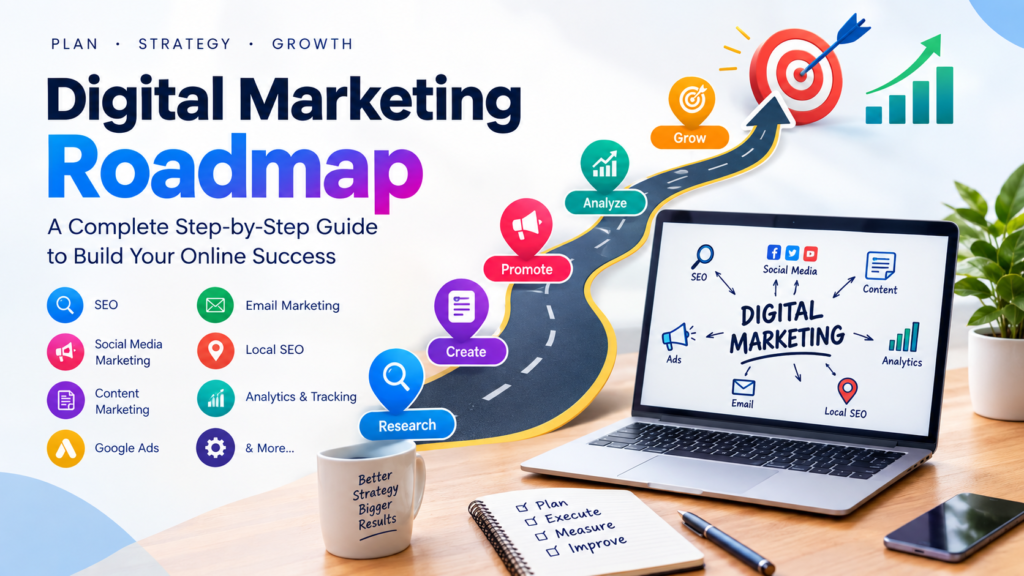
Digital marketing has become one of the most important ways for businesses, brands, startups, freelancers, and professionals to reach their target audience. Today, customers use search engines, social media platforms, websites, videos, online reviews, and other digital channels before making purchasing decisions.
Whether you are starting a new business, building your personal brand, launching an online store, or trying to generate more leads for an existing company, having a clear digital marketing strategy can help you understand what to do first, what to do next, and how to measure your progress.
However, digital marketing can feel confusing when you are just starting. There are many different areas such as SEO, social media marketing, Google Ads, content marketing, email marketing, website development, analytics, branding, and conversion optimization.
This is where a Digital Marketing Roadmap becomes useful.
A roadmap gives you a structured path that you can follow step by step instead of trying everything at the same time. It helps you build a strong foundation first and then gradually add more advanced marketing strategies.
In this complete guide, we will explain a practical digital marketing roadmap that beginners, small businesses, startups, freelancers, and marketing professionals can use to build and improve their online presence.
What Is a Digital Marketing Roadmap?
A Digital Marketing Roadmap is a step-by-step plan that explains how a business can build its online presence, attract the right audience, generate leads or sales, and measure marketing performance.
Instead of randomly posting on social media, running advertisements, or writing blogs, a roadmap helps you connect different marketing activities together.
A basic digital marketing roadmap can include:
- Understanding your business
- Identifying your target audience
- Researching competitors
- Creating a professional website
- Developing a branding strategy
- Keyword research
- Search Engine Optimization
- Content marketing
- Social media marketing
- Google Business Profile and local SEO
- Google Ads and paid advertising
- Email marketing
- Conversion optimization
- Analytics and tracking
- Performance measurement
- Continuous optimization
The exact order can change depending on the business, industry, audience, budget, and goals.
Why Do You Need a Digital Marketing Roadmap?
One of the biggest problems businesses face is doing digital marketing without a clear plan.
For example, a business might:
- Create social media accounts without a strategy
- Publish random content
- Spend money on advertisements without tracking conversions
- Build a website without considering SEO
- Target the wrong audience
- Use too many marketing channels at once
- Focus on followers instead of business results
- Publish blogs without understanding search intent
These activities can consume time and money without producing clear results.
A roadmap helps you answer important questions:
Who are we targeting?
What are we offering?
Where can our customers find us?
What content should we create?
Which marketing channels should we use?
How much should we spend?
How will we measure results?
By answering these questions before executing campaigns, you can create a more organized marketing process.
Step 1: Understand Your Business Goals
Before starting any digital marketing activity, define what you want to achieve.
Different businesses have different goals.
For example:
Local Business
A local business may want:
- More phone calls
- More store visits
- More WhatsApp inquiries
- More Google Business Profile interactions
- More local customers
E-commerce Business
An online store may want:
- More product sales
- More website visitors
- More repeat customers
- Lower customer acquisition costs
- Higher average order value
Service Business
A service company may focus on:
- Lead generation
- Contact form submissions
- Consultation bookings
- Phone calls
- Qualified inquiries
Personal Brand
A professional may want:
- More followers
- More website visitors
- More speaking opportunities
- More clients
- More newsletter subscribers
Your marketing strategy should be connected to your actual business objective.
Instead of saying:
“I want more followers.”
you can define a more measurable objective such as:
“I want to generate 30 qualified business inquiries per month through my website and online marketing channels.”
This makes it easier to measure whether your marketing activities are contributing to the business.
Step 2: Define Your Target Audience
One of the most important parts of any Digital Marketing Roadmap is understanding who you want to reach.
You cannot effectively market to everyone.
Define your ideal customer based on factors such as:
- Age
- Location
- Industry
- Job role
- Interests
- Problems
- Buying behavior
- Budget
- Goals
- Online habits
For example, if you provide digital marketing services to small businesses in Ahmedabad, your audience might include:
- Local shop owners
- Startups
- Service businesses
- Restaurants
- Real estate businesses
- Educational businesses
- Professional consultants
- E-commerce businesses
You should also understand their problems.
They may be asking:
- Why is my website not getting traffic?
- How can I get more customers from Google?
- How can I improve my social media?
- Should I run Google Ads?
- How can I generate leads online?
- Why is my competitor ranking higher?
These questions can later become the foundation of your content strategy.
Step 3: Research Your Competitors
Competitor research helps you understand what other businesses in your industry are doing online.
Search Google for your main services and locations.
For example:
- Digital marketing agency in Ahmedabad
- SEO agency in Ahmedabad
- Google Ads agency in Ahmedabad
- Social media marketing agency in Ahmedabad
Look at the websites appearing in search results.
Analyze:
- Their website structure
- Services
- Blog topics
- Page titles
- Content
- Social media presence
- Reviews
- Offers
- Calls to action
- Local presence
- Content quality
Do not simply copy your competitors.
Instead, identify gaps.
For example, if competitors have basic SEO pages but do not provide detailed guides, you can create more useful educational content.
The goal of competitor research is to understand the market and find opportunities to differentiate your business.
Step 4: Build a Professional Website
Your website is often the central point of your digital marketing strategy.
Social media profiles, advertisements, Google searches, blogs, and other marketing channels can send visitors to your website.
A professional website should clearly communicate:
- Who you are
- What you offer
- Who you serve
- Why customers should consider you
- How customers can contact you
Important pages may include:
Home
Your homepage should explain your business and primary services.
About
Tell visitors about your company, experience, approach, and values.
Services
Create clear pages for your main services.
Contact
Make it easy for visitors to contact you.
Blog
Publish useful educational content related to your industry.
Testimonials
Show genuine customer experiences where appropriate.
Step 5: Make Your Website SEO-Friendly
Once your website is created, the next part of the Digital Marketing Roadmap is Search Engine Optimization.
SEO helps search engines understand your website and helps users discover relevant pages through organic search.
Basic SEO includes:
- Keyword research
- Page titles
- Meta descriptions
- Headings
- Internal linking
- Image optimization
- Clean URLs
- Mobile optimization
- Website speed
- Technical SEO
- Useful content
- Structured website architecture
For example, if you provide SEO services in Ahmedabad, you could create a dedicated service page around that service and location.
However, avoid unnecessarily repeating the same keyword throughout a page.
Your content should remain natural and useful.
Step 6: Perform Keyword Research
Keyword research helps you discover what your target audience searches for.
You can divide keywords into several categories.
Short-Tail Keywords
Examples:
- SEO
- Digital marketing
- Google Ads
- Social media marketing
These can be broad and highly competitive.
Long-Tail Keywords
Examples:
- Digital marketing services for small business
- SEO services for local businesses
- How to improve Google ranking
- Best digital marketing strategy for startups
Long-tail keywords are more specific and can help you create content around particular questions or needs.
Local Keywords
Examples:
- Digital marketing agency in Ahmedabad
- SEO company in Ahmedabad
- Web design agency in Ahmedabad
Informational Keywords
Examples:
- What is SEO?
- How does Google Ads work?
- What is content marketing?
- How to do keyword research?
Create content based on the intent behind these searches.
Step 7: Create a Content Marketing Strategy
Content marketing is a major part of a modern Digital Marketing Roadmap.
Instead of only promoting your products or services, create useful content that helps your audience solve problems.
Your content can include:
- Blog posts
- Guides
- Tutorials
- Videos
- Infographics
- Social media posts
- Case studies
- Checklists
- FAQs
- Short videos
- Email newsletters
For example, a digital marketing agency could create articles such as:
- Digital Marketing Roadmap for Beginners
- SEO Tips for Small Business
- How to Improve Local SEO
- Google Ads Guide for Beginners
- Social Media Marketing Strategy
- How to Create a Content Marketing Plan
- WordPress SEO Guide
- Common SEO Mistakes
This content can attract people who are researching solutions before becoming customers.
Step 8: Start Blogging Consistently
A blog can become an important part of your organic marketing strategy.
Instead of publishing random articles, create content around topics that are relevant to your audience.
A useful blogging strategy can include:
Educational Articles
Explain concepts and processes.
Problem-Solving Articles
Answer common customer questions.
Comparison Articles
Explain differences between relevant tools or approaches.
Local Content
Create genuinely useful information for your target location.
Industry Updates
Discuss relevant changes and developments.
Service-Related Content
Explain how your services solve specific problems.
Consistency is more important than publishing an unrealistic number of articles.
Step 9: Build Your Social Media Presence
Social media can help businesses communicate with their audience and distribute content.
Choose platforms based on where your target audience actually spends time.
Possible platforms include:
- YouTube
- X
- Other relevant platforms
You do not necessarily need to be active everywhere.
For example, a B2B company may prioritize LinkedIn, while a visually focused consumer business may focus more on Instagram or YouTube.
Your social media content can include:
- Educational tips
- Industry information
- Behind-the-scenes content
- Customer stories
- Product information
- Short videos
- Infographics
- Blog promotions
- FAQs
Step 10: Develop a Social Media Content Calendar
Posting consistently becomes easier when you plan content in advance.
For example:
Monday
SEO Tip
Tuesday
Educational Reel
Wednesday
Industry Information
Thursday
Blog Promotion
Friday
Business Tip
Saturday
Behind-the-Scenes Content
Sunday
FAQ or Community Post
The exact schedule is not universal. Choose a schedule your business can maintain consistently.
Step 11: Focus on Local SEO
If your business serves customers in a specific city or region, local SEO can be extremely relevant.
Create and maintain your Google Business Profile with accurate information.
Check:
- Business name
- Address
- Phone number
- Website
- Business category
- Opening hours
- Services
- Photos
Encourage genuine customers to leave reviews and respond appropriately to reviews.
You can also create useful location-specific website content when it genuinely helps users.
For example:
Digital Marketing Services in Ahmedabad
could be a relevant service page if you actually provide those services in Ahmedabad.
Step 12: Use Google Ads for Paid Traffic
SEO focuses on organic visibility, while Google Ads can provide paid visibility.
Google Ads can be useful when you want to reach people searching for specific services or products.
Before starting an advertising campaign, define:
- Campaign goal
- Target audience
- Location
- Budget
- Keywords
- Ad copy
- Landing page
- Conversion action
For example, if your objective is lead generation, sending every visitor to the homepage may not always be the most suitable approach.
A dedicated landing page focused on the specific offer can make the customer journey clearer.
Step 13: Create High-Converting Landing Pages
A landing page is designed around a specific marketing objective.
For example:
SEO Services
Landing page elements could include:
- Clear headline
- Service explanation
- Benefits
- Process
- Supporting information
- Testimonials
- FAQs
- Contact form
- Call-to-action
The visitor should quickly understand:
What is being offered?
Who is it for?
Why should I consider it?
What should I do next?
Avoid overwhelming visitors with unnecessary information.
Step 14: Start Email Marketing
Email marketing can help businesses communicate with existing prospects and customers.
You can build an email list through:
- Website forms
- Newsletter subscriptions
- Lead magnets
- Consultation forms
- Purchases
- Event registrations
Possible email content includes:
- Educational newsletters
- New blog posts
- Product updates
- Offers
- Industry insights
- Customer resources
Always collect and use email addresses according to applicable privacy and consent requirements.
Step 15: Set Up Analytics and Tracking
A successful digital marketing strategy requires measurement.
Tools such as Google Analytics and Google Search Console can help you understand website performance and search visibility.
Track meaningful metrics such as:
- Website traffic
- Organic search traffic
- Search impressions
- Clicks
- Leads
- Sales
- Conversion rate
- Cost per lead
- Advertising spend
- Revenue
Do not focus only on vanity metrics such as follower count.
A smaller audience that generates relevant customers can be more useful to a business than a large audience that produces no business results.
Step 16: Understand Conversion Rate Optimization
Getting visitors to your website is only one part of digital marketing.
You also need to make it easy for visitors to take the desired action.
This could be:
- Contacting you
- Calling your business
- Sending a WhatsApp message
- Booking a consultation
- Purchasing a product
- Signing up for a newsletter
Improve your conversion process by making calls to action clear.
For example:
Get a Free Consultation
can be more specific than:
Click Here
Test your forms, buttons, mobile experience, and page structure regularly.
Step 17: Build Your Online Reputation
Trust is an important part of online marketing.
Potential customers may look at:
- Google reviews
- Testimonials
- Social media profiles
- Website information
- Case studies
- Portfolio
- Business information
Make sure your online information is accurate and professional.
Never create fake reviews or misleading testimonials.
Instead, focus on delivering good service and encouraging genuine customers to share their experiences.
Step 18: Build Quality Backlinks
Backlinks are links from external websites to your website.
Relevant and legitimate links can contribute to your website’s overall authority.
Potential sources include:
- Industry websites
- Business directories
- Local organizations
- Professional associations
- Relevant publications
- Guest contributions
- Digital PR
- Useful resources
Avoid focusing purely on quantity.
A large number of irrelevant or manipulative links is not the same as building a strong, relevant online presence.
Step 19: Improve Technical SEO
Technical SEO helps search engines access, crawl, and understand your website.
Important areas include:
- HTTPS
- Mobile usability
- Website speed
- XML sitemap
- Robots.txt
- Canonical URLs
- Broken links
- Redirects
- Indexing
- Structured data
- Website architecture
If your website is built using WordPress and Elementor, keep the CMS, theme, plugins, and other components maintained and updated appropriately.
Be careful when making technical changes on a live website and maintain backups.
Step 20: Create a Strong Internal Linking Structure
Internal links connect different pages on your own website.
For example, your article about:
Digital Marketing Roadmap
could link to:
- SEO Services
- Social Media Marketing
- Google Ads
- Content Marketing
- Website Design
Similarly, your SEO article could link back to your Digital Marketing Roadmap.
This helps visitors discover related information and creates a logical website structure.
Step 21: Use Video Marketing
Video has become an important content format across many industries.
You can create:
- Educational videos
- Tutorials
- Service explanations
- Product demonstrations
- FAQs
- Short-form videos
- Customer stories
You do not always need expensive equipment.
A clear explanation, useful topic, good audio, and relevant presentation can be more important than having a highly complicated production setup.
Step 22: Create a Monthly Digital Marketing Plan
After building your foundation, create a monthly workflow.
For example:
Week 1
- Keyword research
- One detailed blog
- Social media content
- Website optimization
Week 2
- SEO improvements
- Social media posts
- Video content
- Competitor research
Week 3
- New blog
- Backlink outreach
- Google Business Profile activity
- Email newsletter
Week 4
- Analytics review
- Content updates
- Conversion analysis
- Next month’s planning
This makes digital marketing more organized and measurable.
Step 23: Measure What Is Working
After several weeks or months, review your data.
Ask:
- Which pages receive the most organic traffic?
- Which keywords generate impressions?
- Which pages generate leads?
- Which social media content performs well?
- Which campaigns generate conversions?
- Which landing pages need improvement?
- Where are users leaving the website?
Use this information to improve your strategy.
Digital marketing is not a one-time task.
It is an ongoing process of:
Plan → Execute → Measure → Improve → Repeat
Step 24: Avoid Common Digital Marketing Mistakes
Many businesses make avoidable mistakes.
Trying Every Platform
You don’t need to be everywhere.
Focus on channels relevant to your audience.
Posting Without a Strategy
Random content may not support your business goals.
Ignoring SEO
A website without search optimization may miss opportunities to attract relevant organic traffic.
Running Ads Without Tracking
Advertising without conversion tracking makes it difficult to understand performance.
Buying Followers
Follower numbers do not necessarily represent genuine customers or engagement.
Using Low-Quality Content
Publishing large quantities of repetitive or unhelpful content can reduce the value of your website.
Ignoring Mobile Users
Always test your website and landing pages on mobile devices.
Digital Marketing Roadmap for Beginners
If you are completely new to digital marketing, you don’t need to implement everything on day one.
Follow a simple progression.
Month 1 — Foundation
Focus on:
- Business goals
- Target audience
- Competitor research
- Website
- Branding
- Google Business Profile
- Analytics setup
Month 2 — SEO and Content
Focus on:
- Keyword research
- On-page SEO
- Technical SEO
- Blog content
- Internal linking
- Local SEO
Month 3 — Social Media
Focus on:
- Content calendar
- Social media profiles
- Short videos
- Educational content
- Community engagement
Month 4 — Paid Marketing
Start testing:
- Google Ads
- Social media advertising
- Landing pages
- Conversion tracking
Month 5 — Optimization
Analyze:
- Traffic
- Leads
- Conversions
- Search performance
- Advertising results
Improve the areas that need attention.
Month 6 — Scaling
Once your foundation is working, you can expand:
- Content production
- SEO
- Paid campaigns
- Email marketing
- Video marketing
- Partnerships
- Digital PR
This six-month structure is a planning framework, not a guaranteed timeline. Different businesses can progress at very different speeds.
Digital Marketing Roadmap Checklist
Use this checklist to review your progress.
Business Foundation
☐ Define business goals
☐ Identify target audience
☐ Research competitors
☐ Define your unique value proposition
Website
☐ Create professional website
☐ Create service pages
☐ Create About page
☐ Create Contact page
☐ Create Blog section
☐ Make website mobile-friendly
☐ Improve website speed
SEO
☐ Keyword research
☐ Optimize page titles
☐ Write meta descriptions
☐ Optimize headings
☐ Improve URLs
☐ Add internal links
☐ Optimize images
☐ Fix technical SEO issues
Content
☐ Create content strategy
☐ Publish useful blogs
☐ Create educational guides
☐ Create videos
☐ Update older content
Local SEO
☐ Create/optimize Google Business Profile
☐ Maintain accurate business information
☐ Collect genuine reviews
☐ Create relevant local content
Social Media
☐ Choose relevant platforms
☐ Create content calendar
☐ Publish consistently
☐ Engage with audience
☐ Analyze performance
Paid Advertising
☐ Define campaign goals
☐ Research keywords
☐ Create landing pages
☐ Set conversion tracking
☐ Monitor campaigns
Analytics
☐ Set up Google Analytics
☐ Set up Google Search Console
☐ Track conversions
☐ Monitor organic traffic
☐ Review marketing performance
Plan → Build → Promote → Measure → Optimize → Grow.
F.A.Q.
What is the first step in digital marketing?
The first step is to understand your business objective and target audience. Once you know what you want to achieve and who you want to reach, you can choose suitable marketing channels.
Is SEO better than Google Ads?
SEO and Google Ads serve different purposes. SEO focuses on organic search visibility, while Google Ads provides paid advertising placements. The appropriate approach depends on your goals, budget, competition, timeline, and business model.
How long does digital marketing take to work?
There is no universal timeline. Results depend on factors such as industry competition, website quality, content, budget, audience, marketing channels, and execution.
Can a small business do digital marketing?
Yes. Small businesses can implement many digital marketing activities themselves, including content creation, basic SEO, social media marketing, analytics, and local optimization. More technical or complex campaigns may require additional expertise.
How much should a business spend on digital marketing?
There is no single budget that works for every business. Your budget should consider your revenue, goals, customer acquisition economics, competition, marketing channels, and available resources.